
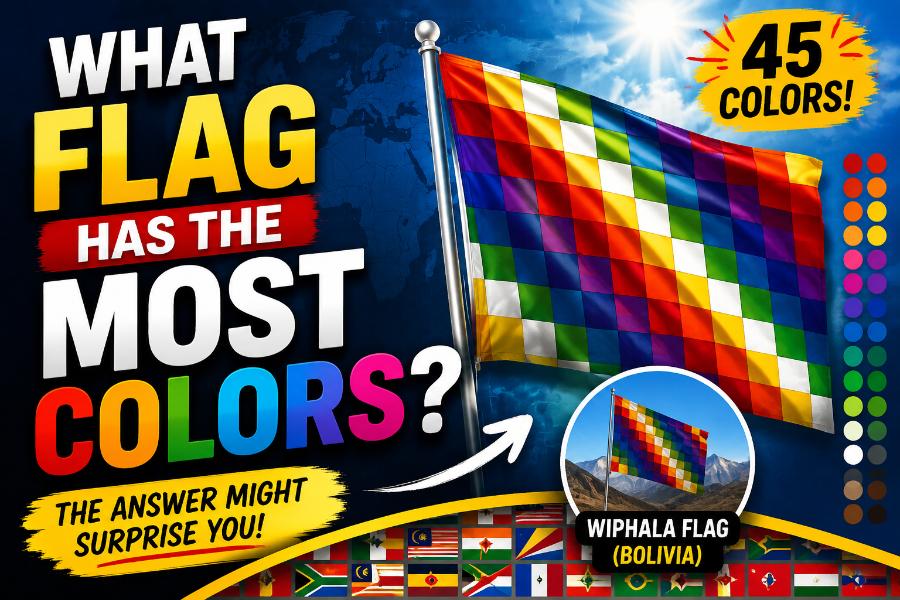
The national flag most often identified as having the greatest number of colors is the flag of Belize. It is widely counted as containing 12 distinct colors, although the exact total can vary depending on how a source treats shades, outlines, skin tones, and small details in the coat of arms. The reason it uses so many colors is not the basic background. The large national coat of arms in the center adds people, tools, wood, foliage, a ship, a shield, and other detailed elements.
That answer sounds simple, but the question “what flag has the most colors?” leads to an interesting discussion about how flags are classified. Some national flags use only two or three broad colors. Others place a detailed emblem or coat of arms on the field, introducing many smaller colors that are easy to miss from a distance. Belize belongs to the second group.
What Does the Flag of Belize Look Like?
The flag of Belize has a royal-blue field with a narrow red stripe along the top and another along the bottom. In the center is a large white disk containing the national coat of arms. A circular wreath of 50 leaves surrounds the central emblem. The overall design is balanced and highly symbolic, but it is much more detailed than most national flags.
At first glance, a viewer may notice only blue, red, and white. A closer look reveals many more colors inside the coat of arms. Brown wood, green foliage, natural skin tones, black outlines and clothing details, yellow or gold elements, and additional colors associated with the shield, tools, and ship contribute to the commonly reported total of 12.
Why Is the Belize Flag So Colorful?
Most of the palette comes from the coat of arms, which represents the historical importance of the mahogany industry to Belize. The emblem includes two workers, woodworking tools, pieces of timber, a mahogany tree, a ship, and a shield. These are not abstract shapes rendered in one or two colors. They are illustrated objects, so each one introduces naturalistic color.
This design approach is different from flags built primarily from geometric bands or crosses. A simple tricolor can be reproduced using three pieces of fabric. A flag with a coat of arms may require detailed printing, embroidery, or careful appliqué. The benefit is rich storytelling; the tradeoff is complexity at a distance.
How Many Colors Are on the Belize Flag?
Twelve is the most frequently repeated answer in flag references and popular educational sources. However, a color count is not as objective as counting stars or stripes. One source may treat light brown and dark brown as separate colors, while another may call both “brown.” One may count flesh tones separately. Another may ignore very small black outlines or white highlights.
Digital files can create even more variation. Anti-aliasing adds transitional pixels around shapes, and different official or commercial artwork may use slightly different shades. For a practical flag-trivia answer, “Belize, with 12 colors” is widely accepted. For scholarly analysis, it is better to explain the counting method and the version of the artwork being examined.
A Practical Breakdown of the Palette
The three large structural colors are blue, red, and white. Blue fills most of the field. Red appears in the two horizontal border stripes. White forms the central disk and also appears in parts of the coat of arms.
The emblem contributes the remaining palette. Green appears in the leaves and vegetation. Brown and tan tones represent wood, the tree, tools, and human figures. Black is used for outlines, clothing, hair, or other details. Yellow or gold appears in selected objects and decorative parts. Additional blues, reds, and natural tones may be distinguished as separate colors depending on the artwork.
This explains why a casual viewer may underestimate the total. Large areas determine the flag’s overall visual identity, while the small emblem details determine its record-setting color count.
The Meaning Behind the Main Colors
The colors of the Belize flag are connected to national history and political identity. Blue and red have associations with the country’s major political traditions, and the white central disk provides a neutral field for the coat of arms. The emblem emphasizes labor, natural resources, trade, and the forestry industry that played a major role in the territory’s economic history.
The wreath contains 50 leaves, a reference commonly connected with 1950, an important year in the nationalist movement. Because the design carries political and historical layers, it is more than a colorful illustration. It is a compact representation of the country’s path, work, resources, and unity.
When Was the Current Flag Adopted?
Belize adopted its national flag on September 21, 1981, the day the country gained independence. The design developed from an earlier flag associated with the People’s United Party, but red border stripes were included to broaden the national symbolism and make the result more inclusive.
The current flag is relatively young compared with many national flags, yet its coat of arms draws from a longer colonial and economic history. That combination of a modern national adoption date and traditional heraldic imagery is one reason the design feels both civic and historical.
Is Belize Definitely the World Record Holder?
Belize is the best answer when the question is limited to current national flags and colors are counted from the detailed emblem. Still, the phrase “most colors” needs boundaries. Are unofficial flags included? What about regional flags, historical standards, military colors, or flags with photographic printing? Are different shades counted separately? Does gold count as yellow, and silver as gray?
If the category changes, the answer can change. Some local, ceremonial, or heraldic flags contain elaborate multicolored scenes. Modern pride and community flags may intentionally use wide palettes. A historical flag may include many painted details. For general geography and national-flag trivia, however, Belize remains the most commonly cited answer.
Other National Flags With Many Colors
Several national flags appear highly colorful because they include coats of arms or multiple symbolic sections. Croatia’s flag has the red, white, and blue tricolor plus a detailed checkerboard shield and a crown of regional emblems. South Africa uses a bold geometric arrangement with six main colors. The Central African Republic combines horizontal bands, a vertical stripe, and a star to produce a five-color design with strong contrast.
Dominica’s flag is another notable example. Its green field carries a multicolored cross, stars, and the sisserou parrot in the center. Mexico, Ecuador, and several Central and South American countries use detailed coats of arms that expand their palettes beyond the obvious field colors. These flags demonstrate that color totals often rise when heraldry or naturalistic imagery is added.
Does More Color Make a Better Flag?
Not necessarily. Color can add meaning, cultural richness, and visual energy, but additional colors also create production challenges. Small details may disappear when the flag is flying, and exact color matching becomes more expensive. A limited palette can be easier to recognize and reproduce.
Traditional flag-design guidance often recommends two or three basic colors with strong contrast. That advice is useful for new designs, but it does not mean every successful flag must be minimal. The flag of Belize is valued because of what it represents, not because it follows a modern simplicity test. Community acceptance and historical meaning can outweigh formal design rules.
How Designers Should Count Colors
To compare flags fairly, first choose an official reference image. Then define whether shades count separately. A strict method might count every distinct specified color in the official artwork. A broad method might group navy and light blue as “blue,” or tan and dark brown as “brown.” Record whether black outlines, white highlights, and metallic colors are included.
Do not count anti-aliased pixels, shadows introduced by a photograph, fading in old fabric, or color changes caused by display calibration. The goal is to measure intended design colors, not every pixel value in a digital image.
How to Create a Multicolor Flag Without Losing Clarity
A designer can use many colors successfully when the overall structure remains simple. Start with one dominant field, create a strong large-scale silhouette, and reserve extra colors for a controlled emblem or pattern. Make sure the flag is still identifiable when the detailed area is reduced to a small shape.
Use repeated colors rather than introducing a new shade for every object. Maintain clear boundaries and avoid placing similar values next to each other. Create a simplified version for embroidery or small digital use if the official design contains complex artwork. This responsive approach allows one identity to work across real-world formats.
Flag Makker is useful for experimenting with limited and expanded palettes. Create a simple base first, then add one color at a time. Compare the versions at small size to see whether each new color improves meaning or only adds noise.
Color Facts That Make Good Flag Trivia
The Belize question is popular because the answer is surprising: the flag does not look like a rainbow from far away. Its record comes from tiny details. By contrast, South Africa’s flag is immediately recognized for six large, clearly separated colors. Libya’s national flag from 1977 to 2011 was famously a plain green field, providing an opposite example of extreme simplicity.
Another useful distinction is between “number of colors” and “percentage of color.” A flag may use many colors in a small emblem but remain overwhelmingly blue or white. A different flag may use fewer colors in nearly equal areas and look more colorful overall. Visual impression and literal count are not the same measurement.
Why the Answer Can Change Between Sources
Color-count disagreements usually come from the difference between visual categories and production specifications. A viewer may describe the Belize flag as blue, red, white, green, brown, black, yellow, and several natural tones. A printer may identify a longer list of exact inks. A vexillologist may group related shades into basic heraldic colors. None of these approaches is automatically dishonest; they are answering slightly different questions.
The source image matters too. Simplified classroom illustrations sometimes reduce the coat of arms to fewer colors, while detailed official artwork preserves subtle differences. Older flags, hand-painted versions, and commercial reproductions may vary. Sun fading can turn navy into a lighter blue and red into orange, but those changes should not be counted as intentional design colors.
For a fair comparison, state the rule before counting. A useful rule is: count each intentionally specified solid color in an official flat artwork, group minor shading variations, and ignore anti-aliasing. Using that kind of method supports the familiar answer of 12 while acknowledging that another carefully explained method may produce a different total.
The Coat of Arms as a Design Lesson
Belize demonstrates the strengths and weaknesses of placing a coat of arms on a national flag. The emblem preserves a large amount of information. It can depict occupations, resources, historical tools, landscape, and national motto imagery in one central composition. For ceremonies, classrooms, government buildings, and close viewing, that richness gives the flag depth.
At long distance, however, the individual objects merge into a single circular badge. Viewers recognize the flag mainly through its blue field, red borders, and white center. This creates a two-level identity: a bold outer structure for recognition and a detailed inner emblem for interpretation. Designers of institutional flags can use the same strategy, provided the simplified silhouette remains distinctive.
A responsive flag system may include an official detailed version and an approved simplified version for small embroidery, app icons, or inexpensive printing. The simplified mark should preserve the same geometry and meaning rather than becoming an unrelated logo.
Frequently Asked Questions
What country flag has the most colors? Belize is widely cited as the current national flag with the most colors, commonly counted at 12.
Why does the Belize flag have so many colors? Its central coat of arms contains people, tools, wood, foliage, a ship, a shield, and other detailed objects rendered in several naturalistic colors.
Does the Belize flag really have exactly 12 colors? Twelve is the common trivia count, but totals can vary depending on whether shades, outlines, and small details are grouped or counted separately.
Which flag has six large colors? South Africa is known for a bold design using six prominent colors: red, blue, green, black, white, and yellow.
Can a good flag use many colors? Yes, especially when the colors carry important historical or cultural meaning. However, designers should preserve contrast, recognition, and reproducibility.
Conclusion
So, what flag has the most colors? For current national flags, the widely accepted answer is Belize, with a commonly reported palette of 12 colors. The count comes mainly from its detailed central coat of arms rather than the blue, red, and white structure visible from a distance.
The flag is a useful lesson for designers and flag enthusiasts. Simplicity can improve recognition, but complexity can preserve history and symbolism. When you create your own design with Flag Makker, use color intentionally: begin with a clear visual foundation, add only the colors that strengthen the story, and test whether the result remains memorable at any size.
Editorial Sources
Key references used to verify factual details:
• Harrison Flagpoles, “Which National Flag Has the Most Colours?”
• Encyclopaedic overview of the Flag of Belize
• North American Vexillological Association, flag design guidance
Approximate article word count: 2,090 words (body only)